
Guide
Introducing routines
Routine is not rigidity. It is the handrail a child holds while they learn to walk down unfamiliar stairs.
Free home-visiting Portage across Wiltshire
Guide
Routine is not rigidity. It is the handrail a child holds while they learn to walk down unfamiliar stairs.
Young children with additional needs are often working harder than we realise simply to predict what is coming next. A routine takes that work away. When a child knows the shape of the day, more of their energy is free for learning, playing and being with you.
Routines also reduce the number of transitions that have to be negotiated from scratch, which is where a great deal of distress lives.
Step by step
Start smaller than you think you need to. One short sequence, repeated identically, is worth more than a whole timetable that lasts three days.
Choose a single part of the day that is currently difficult — bedtime, leaving the house, mealtimes.
Bath, pyjamas, story, bed. No more than four to begin with.
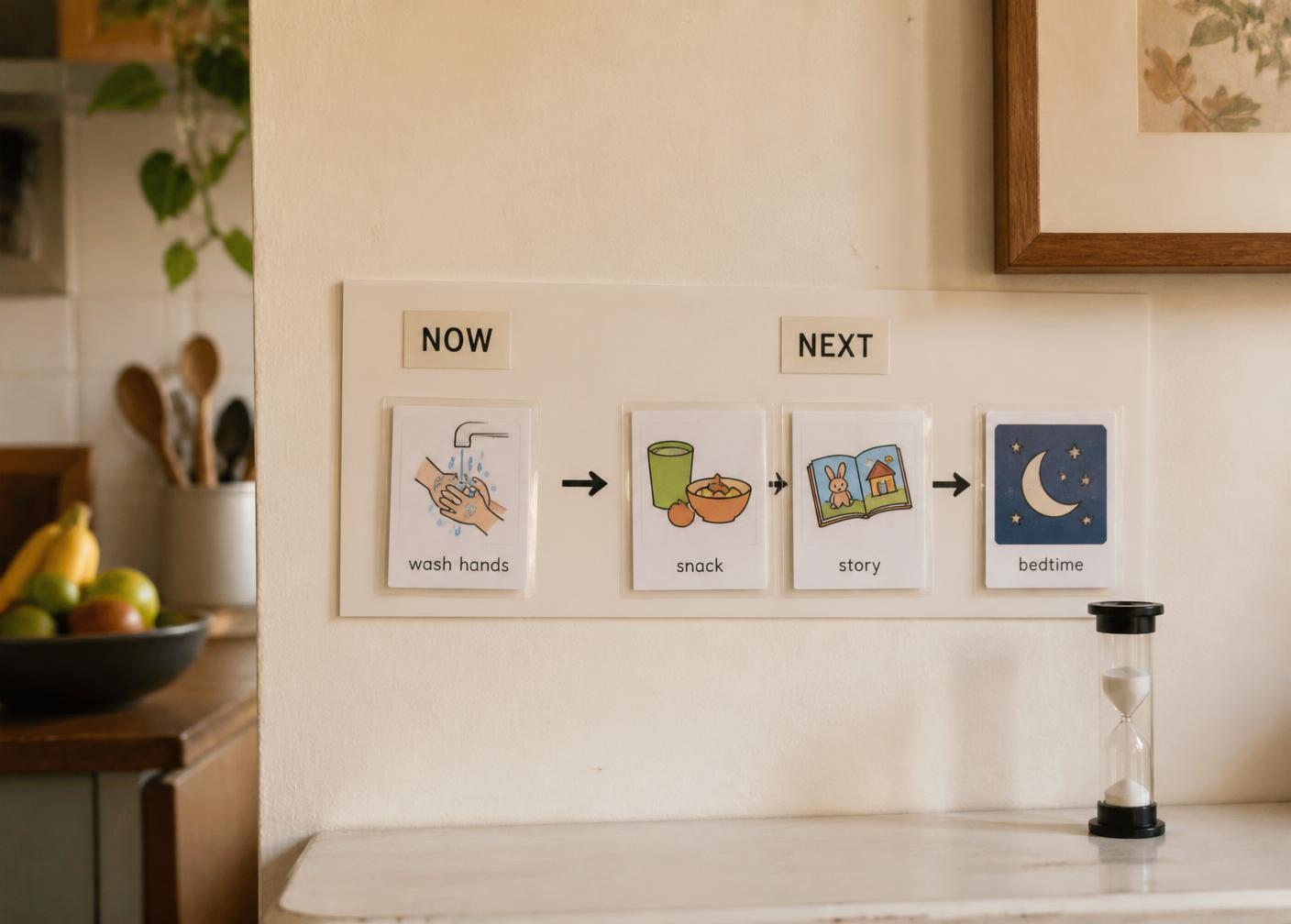
Photographs, drawings or objects laid out left to right. A 'now and next' board is enough.
The same short phrase, the same order. Consistency is the active ingredient.
A sand timer, a song, or a two-minute warning tells a child that a transition is coming.
Give a new routine two to three weeks before you judge it. Illness, holidays and growth spurts will disrupt it — return to it rather than replacing it.
It usually means one of three things: the sequence is too long, the child is not getting anything out of it, or the adults are doing it slightly differently from one another.
Your Portage Home Visitor can help you design a routine around your particular child. Ask at your next visit.
Routines, food, toileting and play ideas — all free to read.