
The model
A method that has worked, quietly, since 1970.
Portage began in Portage, Wisconsin and came to the United Kingdom in 1976. The principles have barely changed, because they keep working.
Principles
What makes it Portage
Portage is a home-visiting educational service for pre-school children with additional support needs and their families. It is structured, evidence-informed and delivered in the place where children learn most: home.
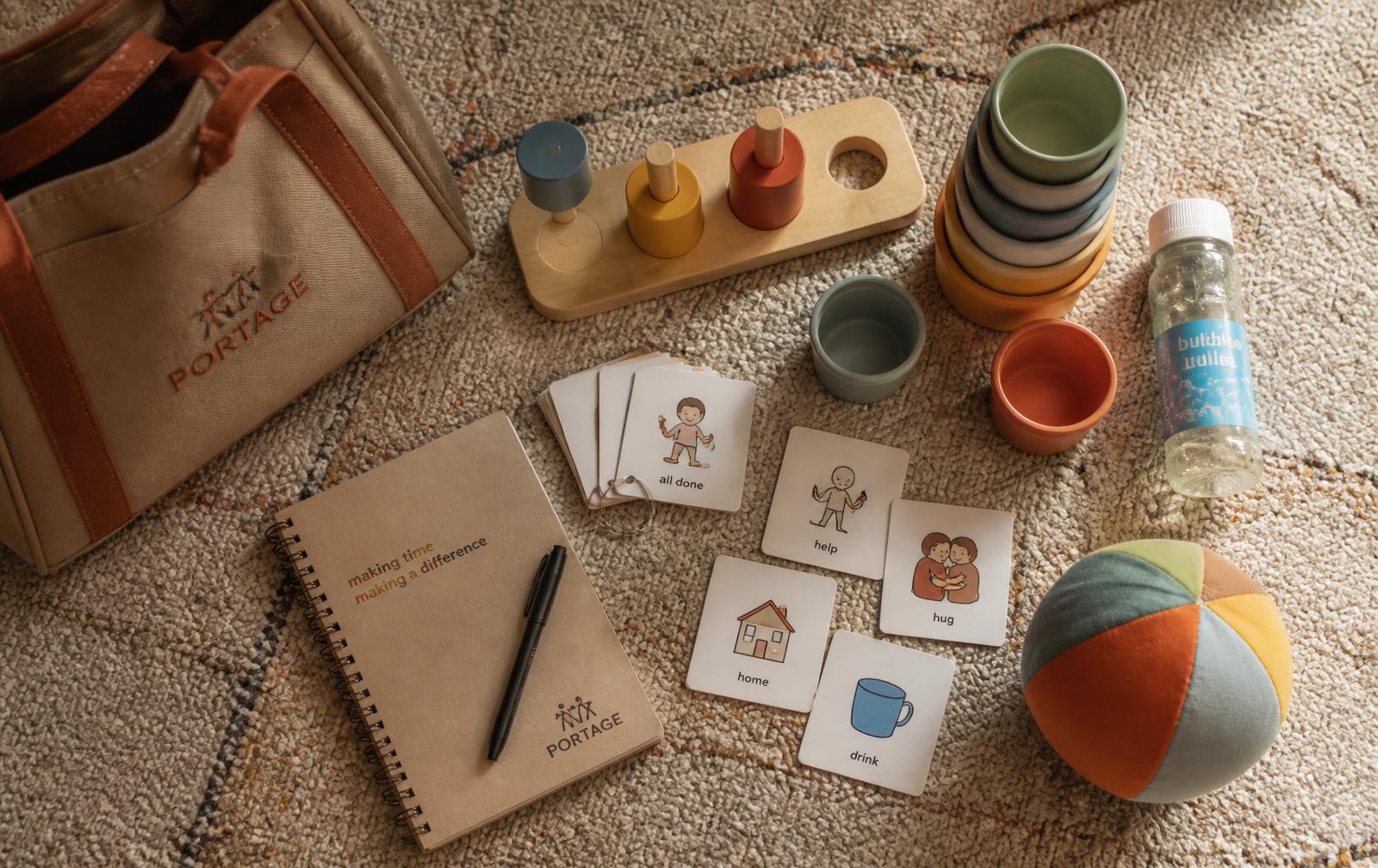
The model rests on a simple idea. Children learn best through play, in familiar surroundings, with the people they trust. So rather than removing a child to a clinic, Portage brings skilled teaching to the carpet, and hands it to the parent.
Partnership with parents
Parents are the constant in a child's life and the primary educators. The Portage Home Visitor is a partner, not an expert dispensing instructions. Priorities are agreed together and reviewed together.
Small steps, recorded
A long-term goal — drinking from an open cup, sharing attention with an adult, walking to the front door — is broken into tiny teaching steps. Each step is taught through play, practised during the week, and recorded. When something does not work, we change the step, not the child.
Structured assessment
We use developmental checklists across social, communication, cognitive, self-help and motor development, alongside observation and the parent's own knowledge. This gives an honest picture of what a child can already do — always the starting point.
Celebrating success
Every success is noticed and named. For families who have had a run of difficult appointments, being told what their child can do is often the thing that changes the week.
Every week
The weekly Portage cycle
Each visit follows the same rhythm, which is part of why it works. Children know what is coming, and so do parents.
Observe
We watch the child at play and note what they are doing now, not what a chart says they should be doing.
Agree
Parent and home visitor agree the next long-term goal and the small teaching step that leads towards it.
Teach through play
The step is modelled in play, with the parent joining in, so that it can be repeated naturally during the week.
Practise
The activity becomes part of ordinary life — bath time, snack time, the walk to the postbox.
Record
Progress is written into the activity chart and the Portage journal, so change over months is visible.
Review and adjust
At the next visit we review. Achieved steps are celebrated; steps that were too big are made smaller.
Around the child
We work with everyone else around your child
Portage does not sit in a silo. Your home visitor liaises — with your permission — with the professionals already involved:
- Health visitors and community paediatricians
- Speech and language therapists, physiotherapists and occupational therapists
- Specialist centres and children's centres
- Nurseries, pre-schools and childminders
- Wiltshire Council SEND teams and educational psychologists
We also support transition into an early years setting and into school, including contributing evidence to Education, Health and Care needs assessments.
Quality
Training, standards and safety
Our Portage Home Visitors are trained through the National Portage Association and undertake continuing professional development. We follow NPA principles of practice and review our work against them.
Everyone who works or volunteers with children through Wiltshire Portage is safely recruited, holds an enhanced DBS check, has references taken up, and works within our safeguarding and child protection policy. Safeguarding concerns are always acted upon.
Refer a child to Portage
Parents, carers and professionals can all make a referral. It is free at the point of use, paid for by Wiltshire Council and your donations, and no diagnosis is required.